
Lesson 5: Strength, Cardio & Energy Systems — What Actually Works After 40/50
Why This Lesson Exists (A Quick Note before We Begin)
Up to this point in the course, we have focused on building a strong foundation — proper training structure, nutrition, and consistency. For most people, that is more than enough to achieve excellent results.
However, as you progress, you may reach a stage where doing “more” is no longer the answer. Training longer, adding extra cardio, or increasing intensity without strategy can start to work against you —especially after 40/50, when recovery becomes a key factor.
This is why I’m adding this lesson.
It brings together a few more advanced concepts that I use personally and have explored further over time:
- how different types of training actually target the same energy systems
- how to structure training more intelligently instead of just increasing volume
- and how to adjust your approach based on your individual response (your “metabolic type”)
This lesson is not a replacement for what you’ve already learned—it’s an extension.
If you are still building consistency, keep following the earlier structure.
If you feel ready to optimise, refine, and train smarter rather than harder, this will give you the next layer.
Part 1: Why Cardio Is Not the Foundation (And What Is)
Most people believe that staying lean after 40 or 50 requires more cardio.
More effort. → More sweating. → More “burning calories.”
In reality, body composition is not driven by how many calories you burn during a workout.
It is driven by how your body handles energy during the other 23 hours of the day.
This is where strength training becomes the foundation.
You do not need to “burn more.”
You need to signal your body differently.
What most people miss about fat loss
Fat loss is often treated as a math problem:
- Burn more calories
- Move more
- Eat less
But the body does not respond only to calories.
It responds to:
- muscle mass
- hormonal signals
- insulin sensitivity
- recovery state
This is why two people eating the same calories can look completely different.
What strength training actually does
When you train with weights consistently, you are not just using energy — you are changing how your body uses energy.
Strength training:
- increases muscle mass
- improves insulin sensitivity
- raises resting metabolic rate
- improves glycogen storage
- strengthens the nervous system
- improves recovery capacity
This shifts where calories go.
More toward:
- muscle repair
- recovery
- tissue maintenance
Less toward:
- fat storage
That is why it becomes possible to eat normally — even generously — and remain lean.
Why more cardio is not always better
High-intensity cardio methods (HIIT, sprint intervals) are effective tools.
But they are also demanding:
- on the nervous system
- on joints and connective tissue
- on recovery capacity
After 40/50, recovery becomes the limiting factor.
If you already train with weights:
- adding more intensity does not always improve results
- it often just adds fatigue
This is where many people plateau.
Cardio still has a place
Cardio is not the enemy.
It is valuable for:
- cardiovascular health
- VO₂ max
- general fitness
- mental well-being
But for body composition:
Strength training should be the anchor.
Cardio should be the complement.
A simple structure works well:
- 3–4 strength sessions per week
- 1–2 cardio sessions (optional)
The underestimated tool: walking
Walking is one of the most effective (and most ignored) tools.
It:
- supports recovery
- improves blood flow
- helps regulate blood sugar
- reduces stress hormones
- increases daily energy expenditure without fatigue
This is often called incidental cardio or NEAT (Non-Exercise Activity Thermogenesis).
It matters more than people think — especially after 40.
Part 2: Energy Systems — the Overlap between Strength and Cardio
The body does not recognise “cardio” or “weights.”
It responds to:
- intensity
- duration
- recovery
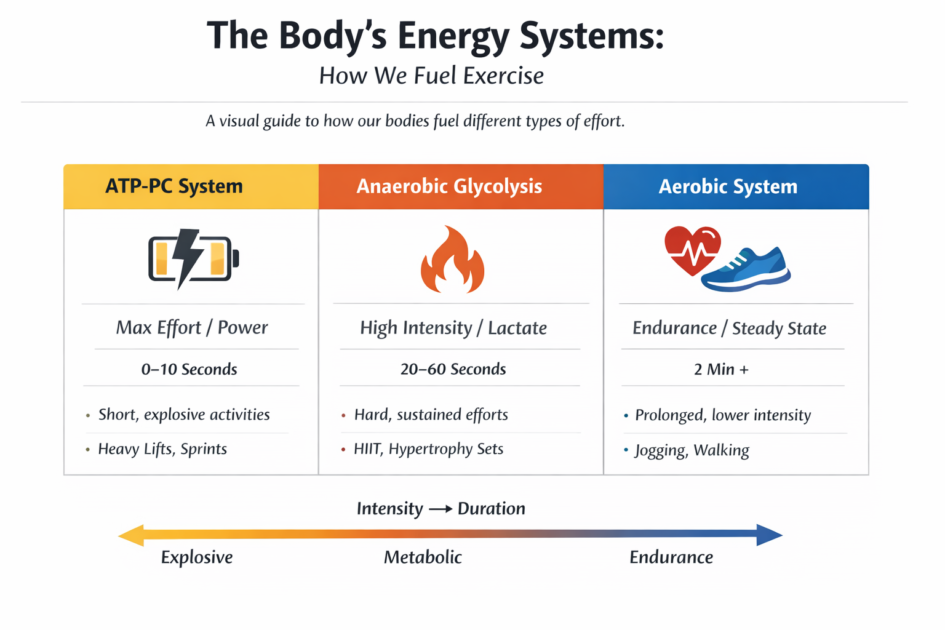
There are three main energy systems:
1. ATP–CP System (0–10 seconds)
- maximal power
- explosive effort
- full recovery required
Used in:
- heavy strength training (2–6 reps)
- sprint intervals (10–20 seconds)
2. Anaerobic Glycolysis (10–60 seconds)
- high effort
- limited oxygen
- “burning” sensation
Used in:
- hypertrophy training (8–12 reps)
- HIIT intervals (30–60 seconds)
3. Aerobic System (minutes to hours)
- low intensity
- sustainable effort
Used in:
- walking
- steady-state cardio
The key insight:
Strength training and cardio often train the same systems.
- Heavy lifting = same system as sprint intervals
- Hypertrophy training = same system as HIIT
Different tools.
Same internal response.
This is why strength training alone can:
- improve metabolism
- support fat loss
- build endurance capacity
Part 3: Hybrid Training — When You Want Both
Once you understand the overlap, you can combine methods efficiently.
Hybrid training means:
strength + conditioning in one structured session
1. Sprint Interval Training (SIT)
- 10–20 seconds maximal effort
- 90–120 seconds recovery
- 6–10 rounds
Use: improve insulin sensitivity, power, conditioning
Note: very effective, but demanding — use sparingly
2. HIIT (High-Intensity Interval Training)
- 30–60 seconds hard effort
- shorter rest periods
Use: metabolic conditioning
Note: higher fatigue cost — not always needed if lifting regularly
3. The “Cardio Sandwich”
Structure:
- Strength exercise
- 20–30 seconds cardio
- Strength exercise
Example:
- Squats → high knees running in place → squats → rest
Benefit:
Maintains muscle signal while increasing energy demand
4. EMOM (Every Minute on the Minute)
- Start a small circuit every minute
- Rest with remaining time
Example:
- 5 squats
- 5 push-ups
- 5 rows
Benefit:
Builds work capacity and recovery efficiency
5. Tactical Circuits
- 3–5 exercises
- back-to-back
- short rest between rounds
Benefit:
Efficient full-body conditioning
Part 4: Training Based on Your Metabolic Type
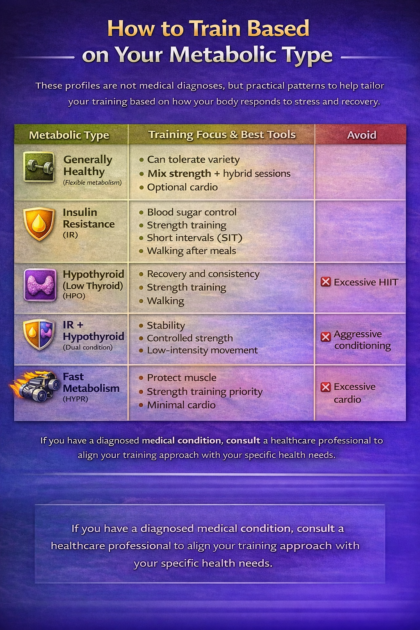
Please note that these profiles are not medical diagnoses, but practical patterns that can help you adjust training based on how your body responds to stress, recovery, and nutrition.
Your “engine” affects how much stress you can handle.
Generally Healthy
- Can tolerate variety
- Mix strength + hybrid + optional cardio
Insulin Resistance
- Focus: blood sugar control
- Best tools:
- strength training
- short intervals (SIT)
- walking after meals
Hypothyroid (Low Energy)
- Focus: recovery and consistency
- Best tools:
- strength training
- walking
- Avoid:
- excessive HIIT
IR + Hypothyroid
- Focus: stability
- Best tools:
- controlled strength training
- low-intensity movement
- Keep intensity moderate
Fast Metabolism
- Focus: preserving muscle
- Best tools:
- strength training
- Limit:
- excessive cardio
***
Please note: If you have a diagnosed medical condition such as thyroid disease or insulin resistance, it is always advisable to align your training approach with guidance from a qualified healthcare professional.
Final Takeaway
You do not need more exercise.
You need the right signals.
- Strength training drives adaptation
- Cardio supports health
- Walking supports recovery
- Recovery determines results
After 40/50:
Doing more is not better.
Doing what works — consistently — is.
FOCUS → DECIDE → COMMIT → REPEAT