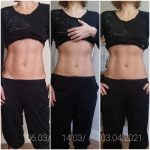

Why I Stay Lean at 52 without HIIT, SIT, or Cardio
The Energy Systems Most People Train With Cardio — I Train With Weights
How strength training quietly covers the same metabolic ground — without exhausting your nervous system
Most people assume that staying in shape after 50 requires more cardio, more effort, and more punishment.
I do none of that.
I don’t do HIIT.
I don’t do sprint intervals (SIT).
I don’t “burn calories” on purpose.
I train with weights 5–6 times per week, usually for about an hour. I walk my dog daily. That’s it.
I’m 52, 163 cm tall, eat roughly 2000–2200 calories per day, and I don’t accumulate unwanted fat.
This isn’t genetics.
And it isn’t luck — at least not the kind people mean.
It’s about which energy systems you train — and how often you signal your body to adapt.
The part most people miss about fat loss
Fat loss is often framed as a cardio problem.
Burn more calories.
Raise your heart rate.
Sweat harder.
But body composition is not governed by how much energy you burn during a session.
It’s governed by how your body handles energy the other 23 hours of the day.
That’s where strength training quietly changes everything.
Energy systems: the overlap nobody talks about…
…or I haven’t heard anybody talking about.
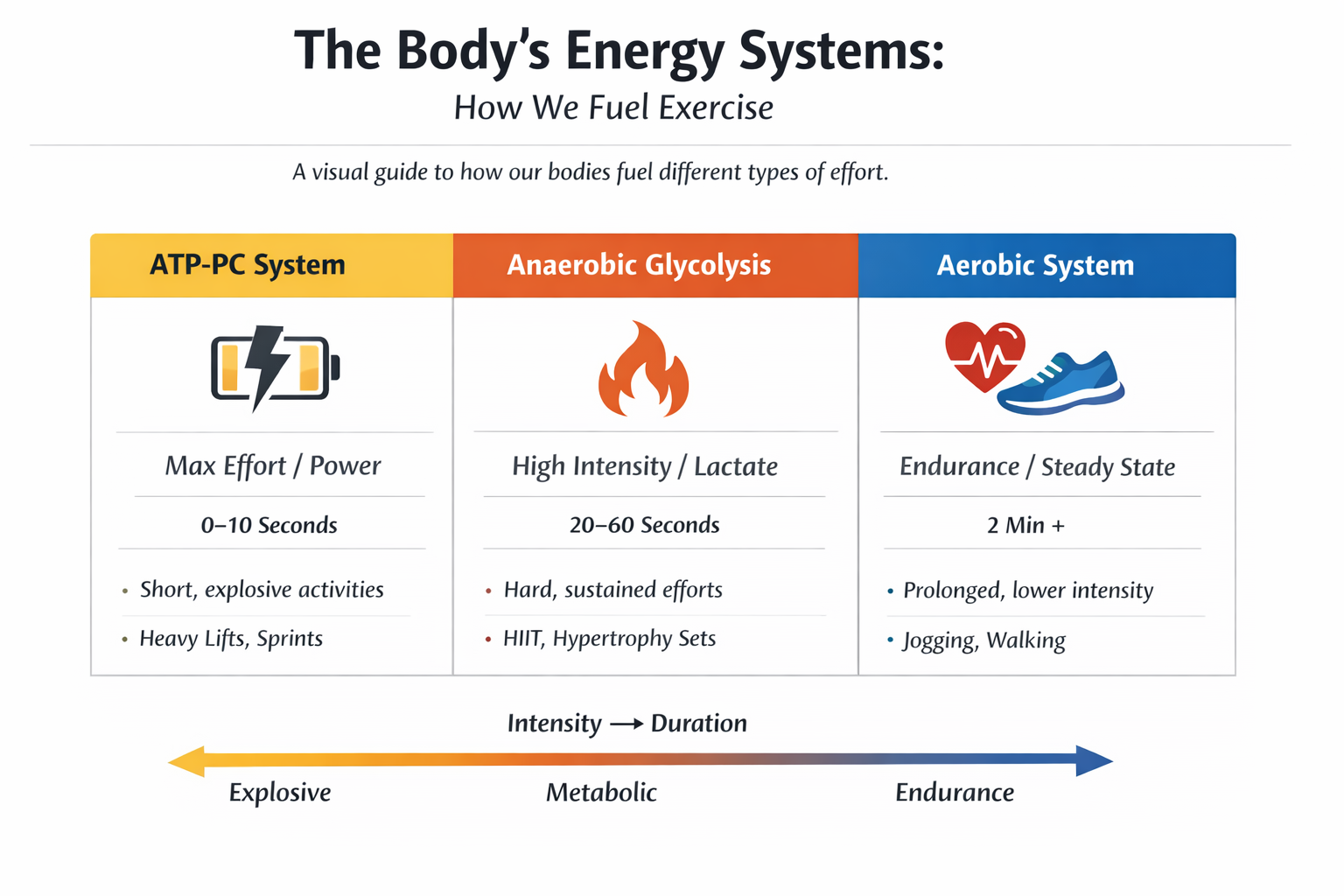
Let’s simplify without dumbing this down.
The body uses three main energy systems:
- ATP–CP (phosphagen system)
Very short, high-power efforts
~0–10 seconds
Heavy lifts, jumps, sprints - Anaerobic glycolysis
High effort, limited oxygen
~10–60 seconds
Hard sets, intervals, intense effort - Aerobic system
Lower intensity, sustained
Minutes to hours
Walking, jogging, steady cardio
Now here’s the key insight:
Heavy lifting and interval training stress the same metabolic machinery
They simply arrive there through different tools.
- Sprint Interval Training (SIT)
10–20 seconds all-out
Long rest
ATP–CP dominant - Heavy strength training (2–6 reps)
Short, maximal effort
Long rest
ATP–CP dominant
And:
- HIIT
30–40 seconds hard
Short rest
Anaerobic glycolysis dominant - Hypertrophy training (8–12 reps)
30–50 seconds under tension
Controlled rest
Anaerobic glycolysis dominant
Different tools.
Same energy systems.
The body doesn’t care whether the signal comes from a bike, a sprint, or a barbell.
It cares about intensity, duration, and recovery.
What strength training does that cardio doesn’t
When you lift weights regularly, you’re not just “burning calories.”
You are:
- increasing muscle mass
- improving insulin sensitivity
- raising resting metabolic rate
- improving glycogen storage
- making the nervous system more efficient
- teaching the body to recover faster from stress
This changes how your body partitions energy.
Calories are more likely to go toward:
- muscle repair
- tissue maintenance
- recovery
And less likely to be stored as fat.
That’s why I can eat normally — generously, even — and stay lean.
Why I don’t add HIIT — and don’t need to
HIIT and SIT are powerful tools.
They’re also very demanding on:
- the nervous system
- connective tissue
- recovery capacity
After 40, recovery becomes the bottleneck.
I already create a strong metabolic signal through:
- hypertrophy work (8–12 reps)
- some heavier strength sets (2–6 reps)
- frequent but intelligent training
Adding HIIT on top wouldn’t improve results.
It would simply increase fatigue.
So I don’t stack stress for the sake of appearances.
A quick clarification — cardio isn’t the enemy
Sprint intervals, HIIT, running, jogging — they are all excellent tools for cardiovascular health and for improving VO₂ max.
A healthy heart matters. A lot.
Where these methods are often overvalued is fat loss.
For body composition, they are not uniquely powerful — especially after 40.
If someone has time or recovery capacity for one thing, strength training gives the biggest return:
- muscle preservation
- insulin sensitivity
- metabolic flexibility
- resilience against aging
Cardio is a valuable addition.
It just doesn’t need to be the foundation.
For people who genuinely enjoy cardio, a balanced split works well:
four strength sessions and two cardio sessions per week, on separate days.
The key point doesn’t change.
Strength remains the anchor — cardio becomes a complement, not the driver.
You’ll still get cardiovascular benefits, movement variety, and mental relief —
without sacrificing recovery or muscle.
Why walking works better than people think
I do walk. Every day.
Not as exercise.
As movement.
Walking:
- supports recovery
- improves blood flow
- keeps insulin sensitivity high
- reduces stress hormones
- gives me time to clear my head
It complements lifting instead of competing with it.
This matters far more than chasing calorie burn.
The recovery piece nobody wants to hear
Staying lean isn’t about how hard you train.
It’s about how well you recover.
Sleep.
Food timing.
Stress regulation.
Breathing 4/7/8.
Walking.
Consistency.
If recovery is poor, the body defends itself.
And a defended body holds on to fat.
What this really comes down to
I don’t stay lean because I avoid cardio.
I stay lean because:
- I train the right systems
- I don’t overload recovery
- I lift weights consistently
- I eat enough to support adaptation
- I don’t confuse exhaustion with effectiveness
Strength training gives the body a reason to adapt.
Supplements support the system.
Walking supports recovery.
Stress management keeps the system responsive.
That’s why I feel better at 52 than I did in my 40s.
Not because I do more.
But because I do what actually works — and stop doing what doesn’t.
***
I don’t just write about this — I live it.
If you want to see how this looks in real life, ask questions, or learn how to apply it to your body after 40/50, I host a private Facebook group: Fit Over 40 & 50 Ultimate Club.
👉 Join here: Fit Over 40 & 50 The Ultimate Club
***
Click here if you are interested how to build muscle at 40/50+.